Functional safety (FuSa) ensures that electrical, electronic, and programmable electronic (E/E/PE) systems or equipment operate without unreasonable risk by responding correctly to inputs and actively detecting potentially dangerous conditions. Rather than relying on passive structural protections, functional safety relies on active engineering controls. This involves designing automated diagnostic systems and triggering protective mechanisms to isolate faults and command a controlled transition to a defined safe state, thereby ensuring human and environmental safety throughout the system's entire operational lifecycle.
The Cross-Functional Responsibility Matrix
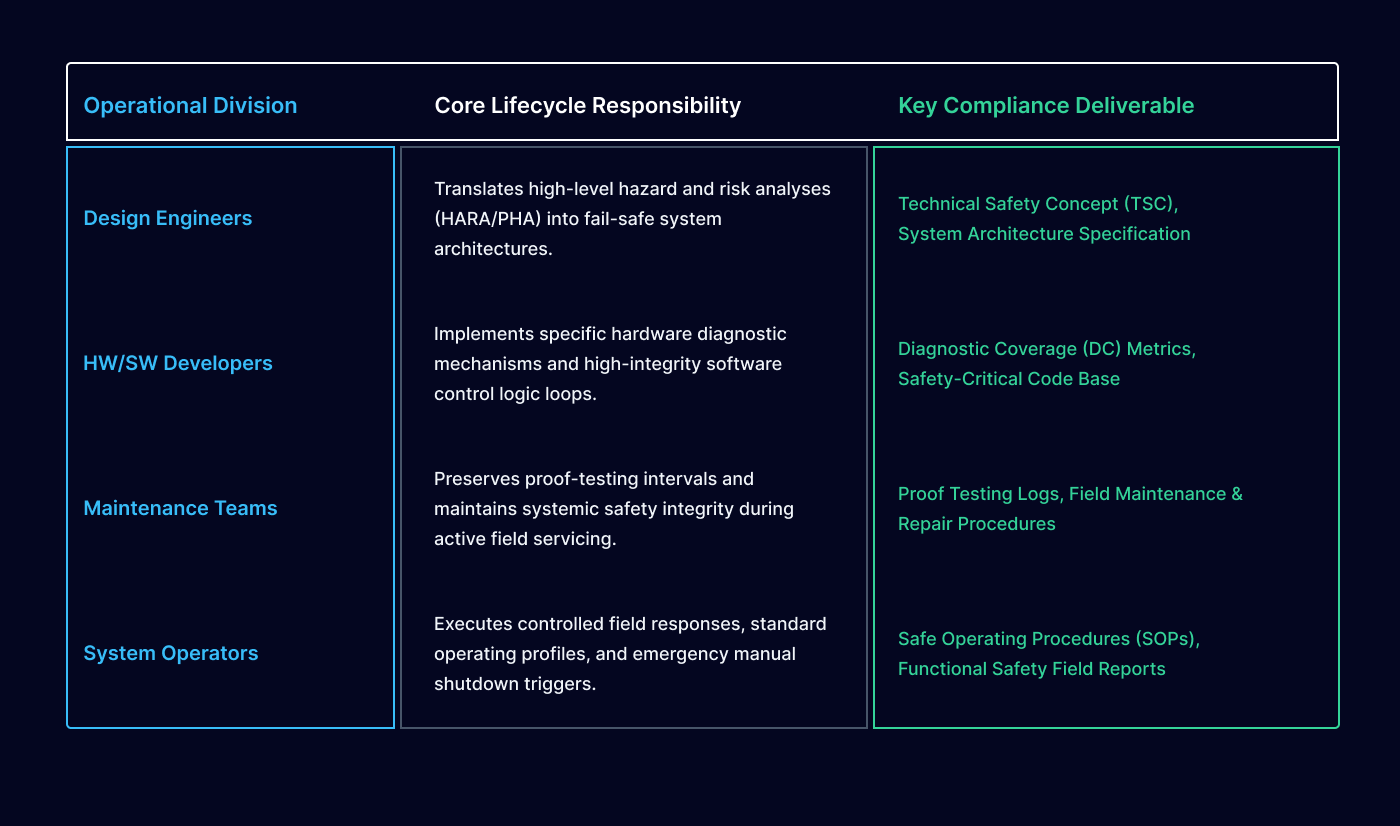
Functional safety compliance cannot be achieved in an engineering silo. It demands active participation and alignment across four core operational divisions within an organization:
1. System Design and Architecture
Engineers and systems architects hold initial responsibility for scoping the equipment under control and identifying high-level systemic risks. Design teams must ensure that their macro-level layouts, voting configurations, and physical interfaces satisfy the rigorous criteria set by international safety regulations. They translate qualitative hazard and risk assessments into explicit technical safety requirements, shaping the primary architecture to prevent failure propagation before a project moves into detailed development.
2. Hardware and Software Development
Hardware and software developers are tasked with implementing the diagnostic capabilities and fallback logic required to maintain system integrity during a fault event. Software developers apply defensive programming techniques, memory isolation, and rigorous code-coverage metrics to prevent systematic software bugs. Concurrently, hardware developers design redundant internal circuits, select safety-rated components, and configure hardware monitoring loops to detect random component failures, ensuring that the physical system reacts predictably to malfunctions.
3. Field Maintenance and Asset Management
Functional safety compliance remains dynamically active long after a product leaves the manufacturing facility. Maintenance technicians and field engineers must possess a thorough understanding of functional safety structures to ensure the continuous compliance and safety integrity of plants, industrial processes, and automated machinery. During routine servicing or part swaps, maintenance personnel must follow strict configuration control procedures to prevent the inadvertent degradation of active safety loops or diagnostic tolerances.
4. Operational Control and Supervision
The operators, field technicians, and plant managers interfacing daily with automated machinery represent the final defensive layer in safety lifecycle management. Operations personnel must possess continuous awareness of active safety alerts, interlock overrides, and human-machine interface (HMI) diagnostic status codes. This training ensures that if a system encounters a fault and enters a degraded operational mode or executes an emergency shutdown, the local team can manage the hazard effectively and execute field recovery protocols without introducing secondary risks.
The Strategic Value of Functional Safety Architecture
Implementing a structured functional safety framework provides three primary benefits to an engineering enterprise:
Systemic Risk Mitigation:
By identifying and resolving technical vulnerabilities early in the requirement phase, organizations systematically lower the probability of dangerous undetected failures, avoiding expensive field failures or late-stage design modifications.
International Market Access:
Conforming to recognized standards guarantees compliance with global safety regulations, effectively clearing technical trade barriers and streamlining procurement cycles with high-value enterprise clients.
Human and Infrastructure Protection:
The ultimate mandate of functional safety engineering is the preservation of human life. Ensuring that complex automated systems can fail safely under all realistic operating profiles protects field personnel, preserves multi-million dollar corporate assets, and defends the long-term reputation of the manufacturer.
Engineering Conclusion
Functional safety is not an optional engineering preference or an isolated technical necessity; it is a fundamental pillar of modern product design. Whether your specific responsibilities center on designing hardware layouts, compiling embedded software code, executing preventative maintenance schedules, or managing live field operations, prioritizing functional safety processes is mandatory to build resilient, trustworthy systems. Developing a robust safety case accelerates commercialization, stabilizes operational uptime, and ensures absolute compliance in an increasingly automated world.